Module Reference · Glitch & Destruction
Stutter / Gate
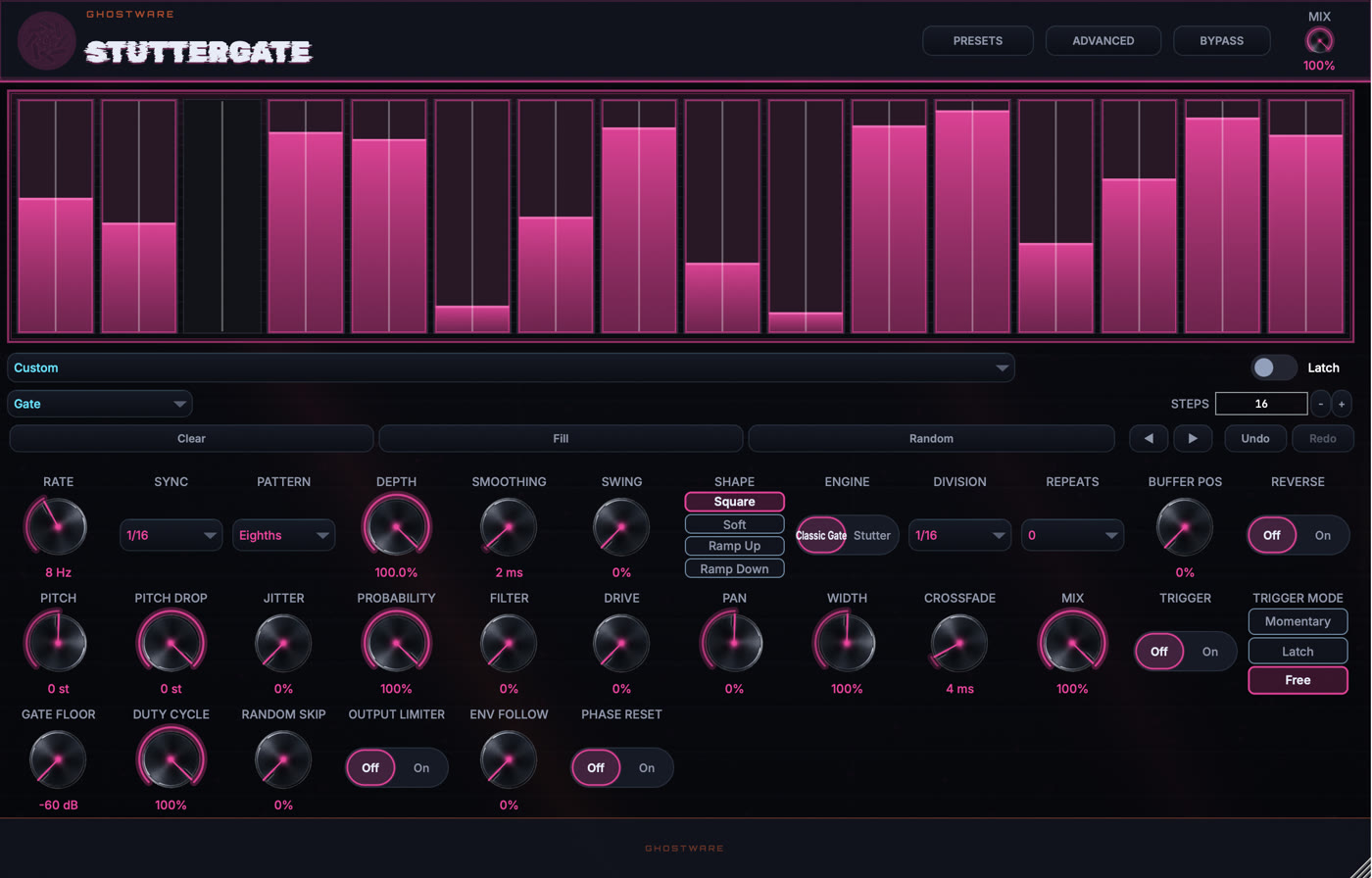
Stutter / Gate is two rhythm machines. The Classic Gate chops the live signal against tempo-synced patterns - and its gate lane is drawn as per-step velocity, bar heights instead of on/off switches, so grooves breathe instead of chatter. Swing, shapes, duty cycle, random skip and envelope following humanize the chop.
The Stutter engine captures slices from a buffer and re-fires them with note-value divisions (triplets and dotted included), pitch shift, progressive pitch drop, reverse, filter sweeps, drive and per-event probability. A manual trigger with momentary, latch and free modes makes it performable, and phase reset locks patterns to playback for perfect repeatability.
Why it hits different
The GhostWare take.
- Velocity lanes - draw the groove's dynamics, not just its holes.
- Pitch-drop stutters for the dying-machine roll.
- Probability and a performable trigger keep it alive, not looped.
In the shot
Reading the panel.
-
1
PATTERN TOOLS
Clear, fill, random, undo - pattern authoring in one bar.
-
2
STEP LANE
Per-step velocity bars: drag heights to write grooves.
-
3
GATE DECK
Rate, swing, shape, engine and trigger modes.
Control Showcase
Every control, explained.
30 controls, named exactly as they appear in the plugin.
Gate speed when not synced to tempo.
Locks the timing to your session tempo at the chosen note value instead of free-running.
The rhythmic pattern the gate follows - Straight, Eighths, Offbeat, Bar Halves, Gallop, Quarters, Broken or Roll.
How deep the gate cuts. This scales the per-step velocity lane you draw in the editor.
Softens the gate edges to remove clicks.
Pushes every other step late for groove.
Gate edge shape: Square, Soft, Ramp Up or Ramp Down.
Classic Gate chops the live signal; Stutter re-plays slices from a buffer with pitch and reverse tricks.
Slice length for the stutter engine, in note values including triplets and dotted.
How many times each captured slice repeats. 0 repeats freely.
Where in the recent audio the stutter slice is captured from.
Plays the stuttered slices backwards.
Pitch shift applied to the stuttered slices.
Pitches each repeat progressively down for the classic dying-machine roll.
Randomizes stutter timing.
Chance each stutter actually fires - lower it for occasional glitches.
Sweeps a filter across the repeats.
Adds drive to the stuttered signal.
Pans the stuttered slices.
Stereo width of the stutter output.
Crossfade at slice edges to keep repeats click-free.
Blend of stuttered signal against the input.
Manual trigger for the stutter - fire it exactly when you want.
How the trigger behaves: Momentary (while held), Latch (toggles) or Free (runs continuously).
How far down the closed gate goes - raise it for partial ducking instead of silence.
How much of each step stays open.
Chance that a step is skipped for broken, humanized patterns.
A safety limiter on the output for hot stutter stacks.
Lets the input's own loudness modulate the gate depth.
Restarts the pattern from step one whenever playback starts, for locked repeatability.