Module Reference · Space & Stereo
FLAGSHIPA new kind of reverb — The Golden-Ratio Series
FibraVerb
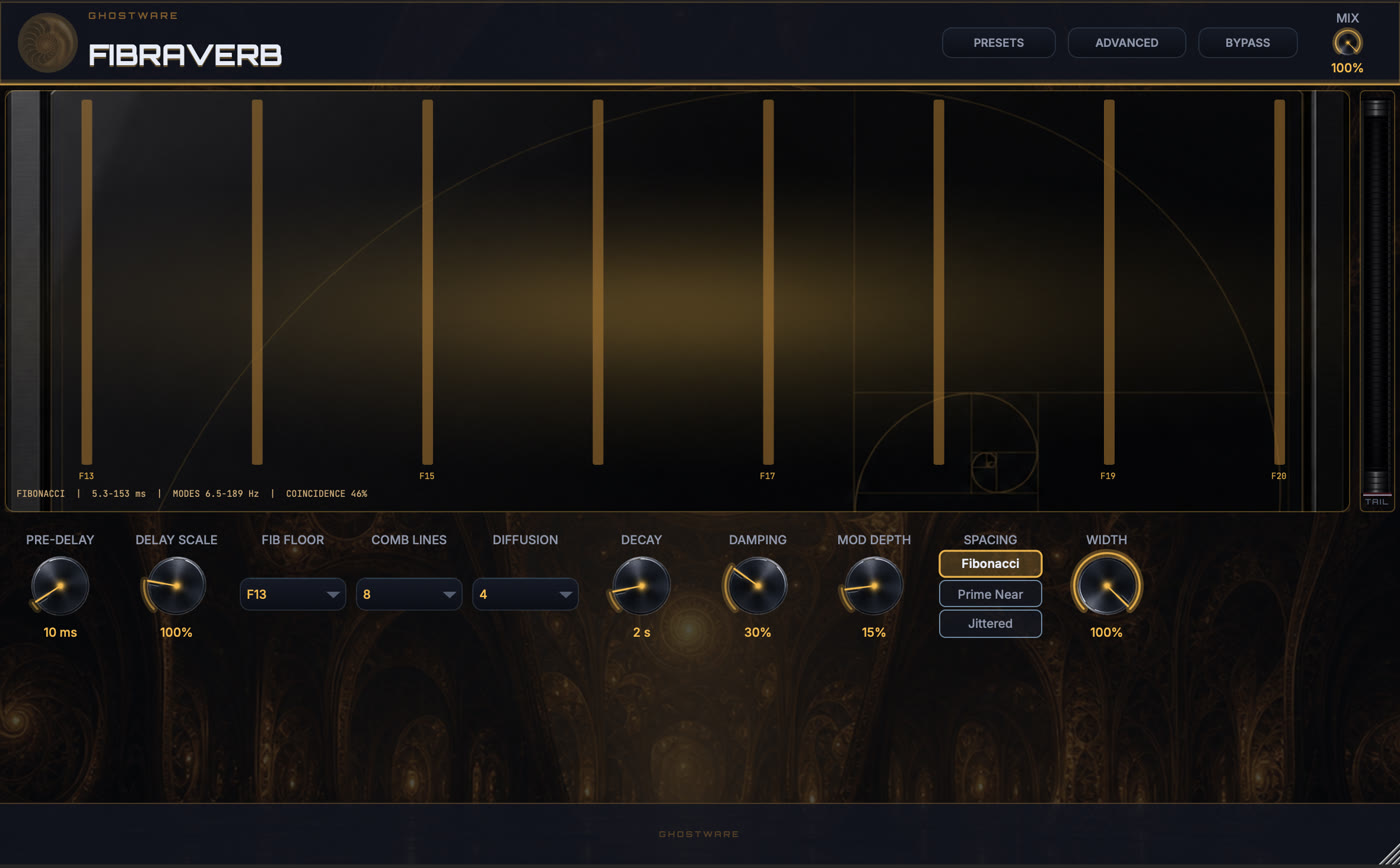
FibraVerb builds its space from mathematics instead of a room model. Its feedback network runs 4 to 12 delay lines whose lengths are seeded from consecutive Fibonacci numbers, so every pair of lines sits at the golden ratio - the spacing that keeps echoes from ever lining up on a shared resonance. The Fib Floor control picks which Fibonacci number seeds the shortest line (F10 to F18), Delay Scale stretches or shrinks the whole lattice from tight metallic chamber to vast slow hall, and a Diffusion stack of 2 to 8 allpass stages smears the input before it enters the lattice.
Three Spacing laws re-voice the same lattice: pure Fibonacci for the classic golden spread, Prime Near, which nudges each line to a nearby prime number so distant lines stop sharing overtones, and Jittered for a softer, randomized wash. Decay runs from a 0.2-second slap to a 15-second bloom, in-loop Damping darkens the tail as it ages, and a slow golden-angle-staggered modulation keeps long tails alive without chorusing. The editor draws the real lattice - line lengths, spacing law and a mode-coincidence readout - live from the same math the audio path runs.
Why it hits different
The GhostWare take.
- Golden-ratio line spacing - the tail stays dense and even instead of ringing.
- Prime Near and Jittered laws re-voice the lattice with one switch.
- The lattice display is honest: it recomputes the real loop lengths, never a mock.
In the shot
Reading the panel.
-
1
DELAY LATTICE
The real Fibonacci lattice, drawn live from the same math the audio path runs - line lengths, spacing law and mode-coincidence readout.
-
2
TAIL METERS
Wet-tail level plus a per-line loop meter for every active comb line.
-
3
LATTICE DECK
Fib Floor, Comb Lines, Delay Scale and the Spacing law, with decay, damping and modulation beside them.
Control Showcase
Every control, explained.
11 controls, named exactly as they appear in the plugin.
Balance between the dry signal and the reverb.
Gap before the reverb starts - keeps the dry signal clear in front of the space.
Stretches or shrinks the whole delay lattice - low reads as a tight metallic chamber, high as a vast slow hall.
Which Fibonacci number seeds the shortest delay line (F10 to F18) - higher floors start the whole lattice longer and roomier.
How many golden-ratio-spaced feedback lines build the tail. More lines mean a denser, smoother wash.
How many diffusion stages smear the input before it enters the lattice - more stages soften the attack of the reverb.
How long the tail rings out, from a 0.2-second slap to a 15-second bloom.
Rolls the highs off inside the loop on every pass, so the tail darkens naturally as it ages.
Slow movement inside the delay lines that keeps long tails alive without chorusing.
The lattice law: Fibonacci is the pure golden spread, Prime Near nudges lines to nearby primes so they stop sharing overtones, Jittered adds a soft randomized wash.
Stereo width of the reverb.