Module Reference · Motion & Modulation
Filter Motion
Filter Motion is a filter with an engine room. Nine types - low-pass, high-pass, band-pass, notch, comb, vowel, phaser, formant and a resonant ladder - with drive, selectable slope, and up to twelve phaser stages.
Movement comes from two sources at once: a tempo-syncable LFO with four shapes and stereo phase offset, and an envelope follower with adjustable attack and release that lets the input's own dynamics play the cutoff. Auto-wah, synced sweeps, vowel talk and slow phaser drift all live here.
Why it hits different
The GhostWare take.
- Nine filter personalities, from surgical to vocal to ladder scream.
- LFO and envelope modulation simultaneously - motion with a pulse.
- Stereo phase offset turns any sweep into a wide, rotating one.
In the shot
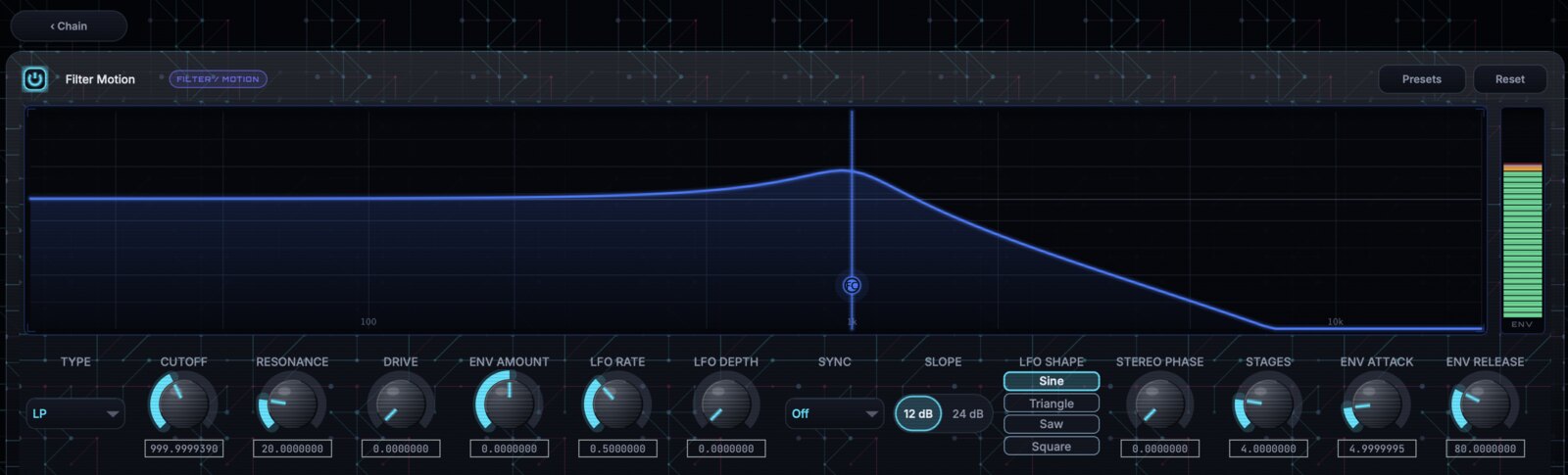
Reading the panel.
-
1
FILTER CURVE
Cutoff peak swept by LFO and envelope, live.
-
2
ENV METER
Envelope follower drive.
-
3
MOTION DECK
Type, cutoff, resonance, LFO shape and stages.
Control Showcase
Every control, explained.
15 controls, named exactly as they appear in the plugin.
The filter itself: LP, HP, BP, Notch, Comb, Vowel, Phaser, Formant or the resonant Ladder.
The corner frequency of the filter.
Emphasis at the cutoff - high values scream.
Pushes the signal into the filter for analog-style growl.
How much the input's loudness pushes the cutoff around (positive opens, negative closes).
Speed of the cutoff LFO when not synced.
How far the LFO sweeps the cutoff.
Locks the timing to your session tempo at the chosen note value instead of free-running.
Blend between the untouched signal and the processed one. 100% is fully wet.
Filter steepness: 12 or 24 dB per octave.
LFO waveform: Sine, Triangle, Saw or Square.
Offsets the LFO between channels for stereo movement.
Number of stages for the Phaser type - more stages, deeper notches.
How fast the envelope follower reacts to level rises.
How fast the envelope follower relaxes.